
Sale of a Car
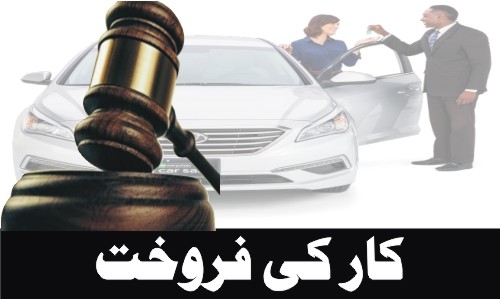
Question: I had sold my car, and about a year after selling it, the police showed up at my house. I said, tell me, what's the matter? He said, I'm looking at your face and reading it, and I've concluded that you have no idea about any incident, you're sitting here so calmly. I said, well, if I had done something, it would show on my face, wouldn't it, not that I'd have done something or not, who knows. He said three people have been murdered, and the car the accused arrived in, while they were fleeing, the tyres got burst by gunfire from the enraged opposing party, and the accused abandoned that car right there and fled, and that car is registered in your name. At this his own face showed worry, he had taken my phone number.
Solution: Luckily, his call came in right at the moment I had the receipt in hand. He said, exactly. I said, show this receipt to this policeman, that I sold this car to such-and-such person a year and a half ago.
Now the question arises: after selling a car, after selling a motorcycle, what should you actually do, and what difficulties will you face if you don't do it? In that triple-murder case, he narrowly avoided being implicated because he had the receipt, and all the neighbours also testified, saying, sir, we are witnesses to this, that he had sold this car a year and a half ago. Even so, the poor fellow had to spend some money to get that fact formally recorded, that the car was no longer in his ownership.
To avoid such disasters, you should follow the law. I'm not saying you need to be extremely careful, but at least be careful to some degree. You sold the car, you took the receipt, good, now your very first job is to immediately notify the Excise and Taxation Department that I sold this car on such-and-such date to such-and-such person, so that the record shows your name is off it, that it's been sold, done.
Now three scenarios come up. Of these three, which is best for you? One I've already told you: sold the car, took the receipt, notified the department, this is the best scenario. Less good than that: the buyer took a receipt but you didn't notify the department. Worst: the buyer didn't even take a receipt. Now I've been asked, if there's a receipt but we didn't inform the Excise and Taxation Department that we sold the car, how much protection does that give? What if the receipt was taken but got lost, how much protection is there then? What if no receipt was taken at all, because friends and acquaintances, it's a society, and society improves gradually, a friend sells to another friend and doesn't take a receipt, but future troubles can arise from this.
Now, the seller who did take a receipt, and the incident I told you about, that poor fellow, that triple-murder case he narrowly escaped because he had the receipt, that's the benefit of the receipt. Even after escaping that, brother, notify them right away that I had sold it, go to the Excise and Taxation Department immediately and get it recorded that I sold it a year and a half ago. Now if the receipt is lost, what do you have to do? You'll have to produce witnesses, saying, these are my witnesses, I sold this car a year and a half ago, six months ago, seven days ago, two days ago, six days ago.
Now here's a really horrific situation, I saw it in one case, and the agencies kept him in custody for about seven months, and released him after seven months. These terrorists, they don't care about money, they have unlimited money.
What happened? A Suzuki Mehran car bomb blast occurred in Lahore, seventeen and a half kilos of explosive material was placed in it and detonated. Two days before the blast, that 2005 model car, two days before this happened, was purchased for 4 lakh 10 thousand rupees, and the seller was quite pleased, thinking, I sold my car for a very good price, I couldn't imagine getting even three-and-three-quarter lakh if I'd taken it to a car dealer, he was quite happy. So they came, made the payment, took the car, the documents, like in a family system, not everyone lives in one house, some in one house, some in another, the documents were in the other house. They said, fine, give us the documents in two days, we'll come back in two days to collect them and give you the receipt then.
Naturally, once a person has over four lakh rupees in hand for the vehicle, he's ready to hand the vehicle over. So the vehicle changed hands, and two days after the vehicle was handed over, the bomb blast happened, and he had no idea, he was sitting at home. He's watching the news on TV that the car has been traced, whose car is it, he's listening to this news when the doorbell rings, he goes outside and it's police everywhere, police everywhere, police at that corner of the street too, police at this corner too, some two hundred fifty, three hundred police in full jackets. He came out and asked, what's happened? They said, sir, are you the owner of this car? He said, no, brother, I sold this car. Sold it to whom? Sold it to such-and-such person. Where's the receipt? Show it. He started to go inside, they grabbed him. They said, tell your family to bring the receipt. They took him away. In the middle of this, the intelligence agencies took him over, took him to an unknown location, he was under investigation for seven months. After the investigation, he was released, confirmed that yes, he had sold that car. These are the pros and cons, I hope that whenever you sell a car in future, you'll keep these precautions in mind.
These are everyday matters, and it's my sincere wish that some forums be established in Pakistan for resolving these small matters. The problem is that the procedure given in Pakistan provides very little for summary proceedings. There are no forums, no separate courts to deal with them, these are half-hour matters, but when someone wants to pursue legal action against another party, an affected party wanting to take legal action against someone, an enormous mouth opens up in front of him, two years, three years, four years of proceedings, fifty hearings, a hundred hearings, and that person then backs off, saying, what can I do, I can't go up against this. But if that other person doesn't do this, and if he gets caught, he too gets ground down in the same mill. That's why the aggrieved person gives up, thinking, where am I going to keep running around courts for two years, which is wrong, but the very person who avoided taking action against the wrongdoer ends up in trouble himself and gets ground down in that same mill.
Comments
No comments yet. Be the first to share your thoughts.