
If a Minor Commits Murder (Part 1)
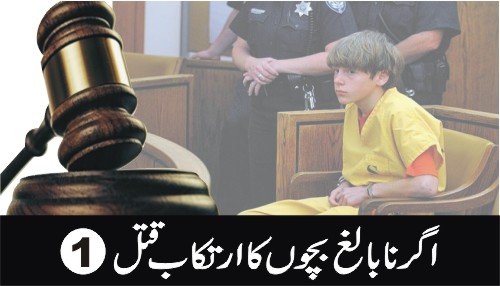
The lecture I'm about to give you today is quite informative, and I'll try to help you not face any difficulty regarding children's matters in future, and this is about those children from whom a crime is committed. I personally would not like to call these children accused, I would call them innocent violators of the law, I wouldn't call them accused, calling them accused doesn't sit right, because children's minds are still developing, and if the poor child has fallen into bad company, it's society's and the state's duty to give him good company. If his parents are criminals, it's the state's duty to protect this child, to give this child an environment in which his mental development happens in a positive way, not a negative way. If children commit crimes, the Juvenile Justice System Ordinance 2000 deals with them. Now what do we call a child? A child is someone under eighteen years of age. What is a borstal institution? An institution, a lock-up, or a detention facility of this kind, where children who have committed some crime are kept, and where, keeping their welfare and their mental development in view, their mental upbringing is nurtured in a positive way, and their sense of things is monitored, whether their inclination is toward crime or toward positivity, toward socialization, they see whether his mind is moving toward socialization, meaning by this that this offence happened, or whether it's moving toward crime, toward criminality, toward relapsing into past criminal tendencies, that whenever there's something positive, he takes a negative angle from it instead of a positive one, then that means his mental upbringing needs to move toward a positive outlook, his mental upbringing needs to happen with a positive outlook. These are the borstal institution's responsibilities. Now what deals with probation in this? Probation means a period during which this child's reform can be achieved. The Probation of Offenders Ordinance 1960 deals with this. Now if a child commits a crime, I don't accept at all that a child commits a crime on his own, whatever the circumstances, I don't accept that a child commits a crime by himself. Circumstances force a child to commit a crime, circumstances make a child commit a crime, the environment makes a child commit a crime, and it's our responsibility, as adults, to raise a child such that he not only turns away from crime but is aware, with a positive sense, that doing this is wrong. Now if, God forbid, some child does commit a crime, the state's first responsibility is to provide him legal aid. This is the first responsibility, to provide him a lawyer, and that lawyer should have at least five years of legal practice. A lawyer with less than five years of practice will not be given, otherwise he'll be a half-baked practitioner. Actually, I'd say a lawyer with ten-plus years should be given so he goes through this process with complete clarity. Now the third element is how the child's age will be determined, how will the court determine that this child is under eighteen years of age? 1. Birth certificate, known as janam parchi, in Punjabi called jamman parchi. 2. B-Form. 3. School leaving certificate. 4. Medical test. 1. First, regarding the birth certificate, the janam parchi. The court will consider this, if, say the child is sixteen years old, and it was registered sixteen years ago that he was born on this day, or he's twelve years old, and it was registered twelve years ago that he was born on this day, then that janam parchi, that birth certificate, that jamman parchi, will carry full credibility, but if a document is presented before the court in the form of a janam parchi, jamman parchi, or birth certificate, registered after the incident occurred, then the court will not accept it. Then 2. the second stage, B-Form. Now the same double test applies to the B-Form too, the court will assess it by the same standard, when was this B-Form made? If the B-Form was made during the normal period after birth, that normal period is three to four years, beyond that it's not counted as within the normal period. 3. Now after the B-Form comes the school-leaving certificate, now the date of birth you enter on the school-leaving certificate can be disputed, a year forward or a year back. If it works out to seventeen and a half years, the school-leaving certificate won't be given weight. Then 4. medical test, when the court reaches a point of confusion with these things, birth certificate, B-Form, school-leaving certificate, when it becomes confused with these things, the court won't be able to clearly determine what the child's age is, then a medical test will be done, called an ossification test, in the ossification test his age will then be determined. Now the ossification test also has a margin, that one year can be confirmed, it can be a year more, it can be a year less, but the lower estimate will be accepted. Now if the ossification test shows the child's age is under eighteen, then the court is duty-bound to treat him as a juvenile. This whole process happens after the challan is submitted, there was an FIR, after the FIR the child was arrested, after arrest the challan was prepared, after the challan was prepared he was produced before the court, after being produced before the court the court clarified this, after clarifying it declared him a juvenile. Now the question arises, if, say, there's a crime, a crime where two adults are with the child, the law says their challans must be submitted together, the child's and the adults' challans must be presented together. After being presented, the court, after declaring him a juvenile, will separate this child's case from those adults. The law says a juvenile is called a juvenile, a juvenile's trial, a juvenile's case hearing, will not happen together with adult accused, it will be separate, it will be separate. Now the matter of arrest comes next, there's no joint trial before you, the determination of age is before you. Now once a juvenile court is formed, then on the day his trial happens, only the juvenile's trial will happen, no other trial. What's the intent behind this? The intent is that the child is considered innocent. I told you, an innocent violator of the law, if a crime has been committed by him in innocence, then he should not be made public. His case proceedings will not be made public. No media, whether print, electronic, or social. No proceedings of this court running under the juvenile system will be made public. When his trial is proceeding, an unrelated person will not be in that courtroom. Now let's come back to our point, when this child is arrested, what are the police's responsibilities? Section 10, Juvenile Justice System Ordinance 2000, as soon as the police arrest a child, first they must inform his guardian. His guardian could be his father, his guardian could also be his mother, his guardian could also be whomever the court has appointed. They must immediately inform him that this child has committed this crime, is in our custody, and inform the guardian that at such-and-such time, on such-and-such date, in such-and-such court, he will be produced, and along with this the police must also warn the probation officer, saying, well, gather all the information about this child within this period, before he is produced in court, to be presented in court, and that probation officer will be duty-bound to present all that information in court: where does this child live, what's the child's age, what does this child do, what do the child's parents do, what are this family's tendencies, is this family involved in crime, has this child committed a crime before, does the environment he's growing up in have significant involvement of criminal people, is there more negative thinking in the environment he's growing up in, is there more inclination toward crime in the environment he's growing up in, or in the environment he's growing up in, in the environment where he's being raised, is earning money through crime considered a business, or, regarding all these things, no, no, no, this child is innocent, his upbringing is innocent too, he was sitting outside in bad company, which is why this happened, whatever the situation is, he'll present a complete report to the court.
Comments
No comments yet. Be the first to share your thoughts.