
Katchi Abadi (Informal Settlements)
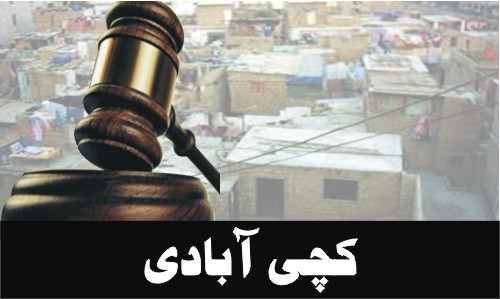
What is a katchi abadi (informal settlement)? What are slums? Homeless people come and settle on some vacant piece of land. First they put up huts, this dates back to the time of Partition, and even today those informal settlements continue. They put up huts there, then after huts they built tin shacks, after tin shacks they built kutcha (mud/temporary) structures, and after kutcha structures they built pucca (permanent) structures. So after Partition, these settlements got established on certain pieces of land across Pakistan, in some places a hundred houses got built on three kanals of land, in some places sixty houses on two kanals, in some places this happened on five kanals. The state then became concerned that these people who are settled here are also citizens of this country, they too have certain rights, so why not legislate so that these people who are settled here get ownership rights to their own homes. This existed even before 1992, but the Katchi Abadi Act was formed in 1992, and after discussing all the problems that had arisen regarding these informal settlements, this law was made. Let me clarify here that some matters reached a point where the state had to step in to maintain law and order, and the state suffered losses from this. To protect itself from further losses, the state introduced the Katchi Abadi Act.
Now, homeless people who had no houses came and settled wherever they could, in groups, after Partition, and they sat there, sat there, sat there, some for forty years, some fifty, some sixty, some sixty-five years, I'm speaking of the present day. So the Katchi Abadi Act 1992 provides that if any group, any settlement of more than 40 houses, has been sitting in one place since before 1985, they can be given ownership rights, they will pay a specified amount, the informal settlement will be officially designated, and they will be given ownership rights. Now the question of whose land it is comes into this. There are broadly three types of land in this country: 1. Federal government land. 2. Provincial government land. 3. Private, ordinary citizens' land. These are the three types of land that exist in this country. Now, regarding the Katchi Abadi Act, it was stated that if this informal settlement, these forty or more houses, are sitting on provincial government property, then it can be designated as a katchi abadi. If they are sitting on federal government property, it cannot be designated as a katchi abadi. And if they are sitting on private land, it also cannot be designated as a katchi abadi, unless the private landowner himself comes forward and says, fine, they've been sitting here a long time, let this be designated as a katchi abadi, with the original owner's consent. Let me clarify one point here: if a person has been sitting on a property for even a hundred years but does not hold ownership, he cannot become the owner if that land belongs to some private individual. The owner remains the owner. So I've given you the three elements of a katchi abadi: first, there must be forty houses, occupying since before 1985, living there in built houses, and third, it must be provincial government property, not private or federal government property.
Now, before this Act, what difficulties did the state face? The state faced the difficulty that people were sitting on private land, sitting there for forty years, they'd say, go ahead, designate it a katchi abadi, close the roads, we won't do that, no, we won't. Then the state had to play the role of a parent, and either bought that property from these private owners and gave it to them, or gave them alternative property in exchange. The state made this Act with the intent of at least getting itself out of this tangle. Now, only a settlement occupied since before 1985, with more than forty houses, on provincial government property, can be designated as a katchi abadi, and they can apply for it. When this Act was made, lists were requisitioned across the whole of Punjab, of settlements on provincial government property with more than forty houses, that could be designated as katchi abadis, there were hundreds of them.
Let me clarify one more point: before designating something a katchi abadi, if one person is sitting on provincial government property, say forty people are sitting there, but those forty houses are spread across forty kanals of provincial government land, the government will not designate that as a katchi abadi. The government also keeps this in mind, that plots should be two, two and a half marlas each, not that one person is sitting on a whole kanal, that unlawful occupants sitting there since before 1985, forty houses spread over forty kanals, will not be designated as a katchi abadi. People who still haven't received ownership rights for their katchi abadi and who meet all these criteria can still apply to the government today, that our property, our settlement, be designated a katchi abadi and we be given ownership rights, but in my estimation, after the 1992 survey, there is no longer any katchi abadi that was occupied since before 1985, with more than forty houses, that hasn't received katchi abadi rights. I don't think there is one, and if there is one, forums are available for it.
Comments
No comments yet. Be the first to share your thoughts.